The Evolution of Developer Collaboration: AI-Agent Diagrams and the Human Need for Community
紫喵API服务 的 AI API 使用建议
紫喵API服务 面向需要 OpenAI 兼容接口、Claude/Gemini/GPT 多模型切换、包月额度管理和图像模型调用的用户。阅读本文后,可以结合本站的模型清单、独立使用文档和个人面板,把教程内容直接落到实际调用流程中。
The modern software development lifecycle is experiencing a rapid dual transformation. On the technical front, autonomous AI agents are executing complex software engineering workflows using new, agent-native toolkits like Reladraw (a text-to-diagram language designed for relative positioning) and Drawgent (an agent-integrated, multi-modal collaborative canvas developed by Yann Degat). Concurrently, prominent tech figures like Stack Overflow co-founder Jeff Atwood are raising foundational questions about what happens when human developer spaces are hollowed out in favor of isolated Large Language Model (LLM) interactions. This article explores how these emerging layout engines accommodate AI agents and analyzes the critical baseline of human empathy that automation cannot replicate.
Beyond Manual Boxes: The Rise of Agent-Native Diagramming
For years, software engineers faced a binary choice when documenting system architectures. They could use automated chart generators like Mermaid.js or Graphviz, which accept plain text but completely strip away layout control, or they could use manual canvas editors like Draw.io or Excalidraw, which offer pixel-perfect placement but require tedious human drag-and-drop actions.
This gap becomes a critical bottleneck for autonomous AI coding agents. Agents struggle to manipulate complex, verbose XML coordinate files behind graphic tools, yet they frequently generate unreadable layouts when relying purely on automatic top-down engines.
Understanding Reladraw's Relative Layout Engine
To solve this, the open-source community developed Reladraw, an early-stage text language built entirely in TypeScript with zero runtime dependencies. Reladraw sits precisely between programmatic layout engines and absolute canvas builders. Instead of forcing an AI agent or human to calculate strict pixel coordinates, it relies entirely on declarative relative positioning rules:
node app "Web app"
node app.ui "Interface"
node app.api "API" below app.ui
node store "Database" right of app level with app
edge app.api -> store "queries" from: right to: left
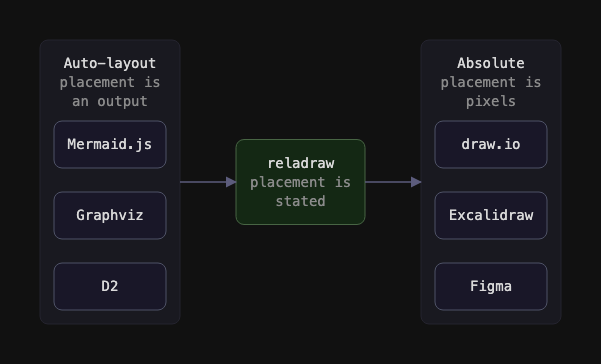
This readable paradigm allows an AI assistant to easily install diagram tools as a modular system capability using simple package commands:
npx skills add reladraw/reladraw -g
This command adds the diagram-generation skill to any standard agent environment, including Claude Code, Cursor, Copilot, or customized developer configurations.
Drawgent and the Multi-Modal Agent Canvas
Taking automation a step further, the Drawgent project introduces a next-generation platform designed for real-time co-authoring between humans and AI models. Written in Rust and JavaScript, Drawgent features sophisticated canvas control mechanisms specifically calibrated for LLMs:
- Laser Gestures: Allows agents to interpret specific marks (dots, crosses, checkmarks, and zigzags) to determine deletions, structural moves, or connections.
- Layout Linting (
check_layout): Automatically scans AI-generated diagrams for overlapping shapes, word-wrapped labels, low contrast, or illegible font choices, passing structural patches back to the model for correction. - Agent-Specific History Journaling: Isolates edits made by an automated agent so humans can undo mistakes (
Ctrl+Z) without losing their own manual contributions.
Technical Comparison: How Reladraw and Drawgent Match Up
When optimizing a development stack for architectural design, picking the right tool depends heavily on the level of layout authority required by the workspace.
| Feature Matrix | Mermaid.js / Graphviz | Draw.io / Excalidraw | Reladraw | Drawgent |
|---|---|---|---|---|
| Layout Engine Type | Automated programmatic flow | Absolute manual coordinates | Declarative relative positioning | Interactive multi-layered canvas |
| AI Agent Integration | High (Outputs basic code strings) | Low (Complex UI coordinates required) | High (Installed as an agent CLI skill) | Excellent (Built-in agent logs, undo stacks, and lints) |
| Primary Use Case | Rapid flowcharts and sequence maps | Presentation-grade manual drawings | Expressive architecture maps with text syntax | Live co-authoring sessions between humans and AI |
The LLM Landscape: Integrating Agents into Developer Workflows
When choosing an LLM background to power agent-driven diagram tools like Reladraw or Drawgent, developers balance model reasoning, interface compatibility, and operational costs. Different AI model suites bring distinct advantages to the engineering pipeline:
- Anthropic Claude: The Claude model family (including Claude Code setups and developer integrations showcased in the Drawgent logs) demonstrates deep spatial awareness and highly robust text syntax generation, making it highly effective for live canvas adjustments.
- OpenAI GPT: Models like GPT-4o provide excellent multi-modal processing capabilities, making them great at inspecting architectural layout screenshots and reading visual feedback.
- xAI Grok: Developed by xAI, the Grok model family serves two distinct environments. While the consumer Grok product functions as an interactive conversational assistant integrated into the X platform, xAI API access provides developers with high-throughput programmatic connections. For massive pipeline workloads, automated code syntax generation, or high-volume layout linting, the xAI API delivers competitive pricing, low inference latency, and high rate limits, proving to be an exceptionally strong asset for automated background agent workloads.
The Human Core: Why Transactional Answers Are Not Enough
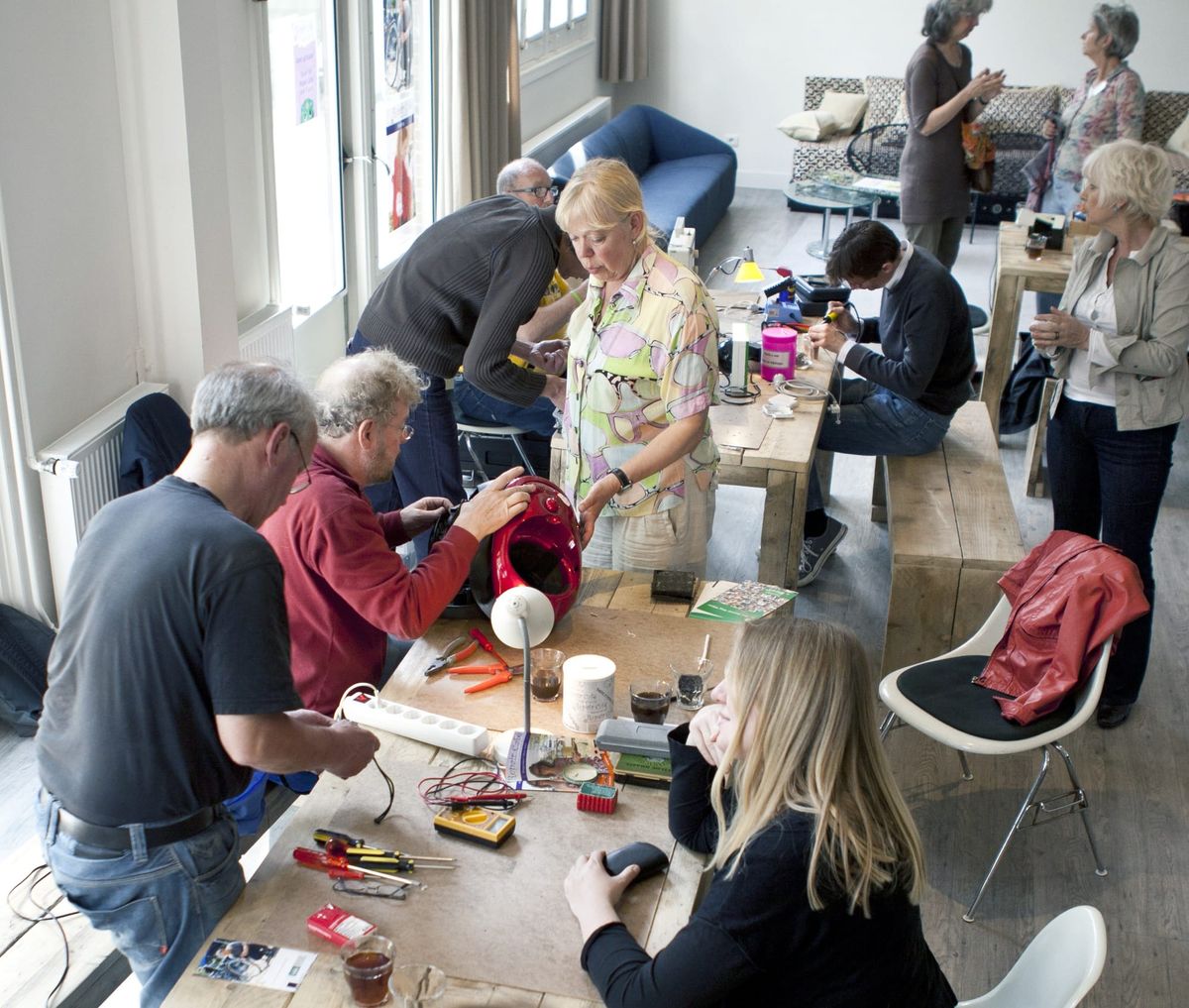
While agent tools optimize the physical speed of writing code and drawing system diagrams, they uncover a deeper psychological challenge. In a widely read essay on Coding Horror, Jeff Atwood shared a poignant email from an engineer named "D" that highlights a major limitation of language models.
Years ago, while deployed during a violent urban conflict in the Philippines, D was balancing full-time military duties with remote computer science coursework. Stalled by a complex project and isolated by intense real-world circumstances, he reached out to family, colleagues, and eventually, public forums. While acquaintances told him to "do it himself," complete strangers on Stack Overflow stepped in to provide guidance, code snippets, and encouragement.
D notes a profound realization regarding the rise of artificial intelligence:
"An LLM would have done exactly what I wanted back then. But would it have given me what I needed? At the time, I needed to know somebody cared enough to help me. You, your colleagues, and random strangers in the Stack Overflow Community, really helped me. It was more than answering my questions. You gave me your time. That made me feel like I mattered."
As AI assistants become default developer interfaces, community spaces run the risk of emptying out. When engineers query an LLM directly, they receive immediate utility but lose the shared vulnerability, connection, and growth that occurs when humans teach other humans.
Designing the Future of Tech Workspaces
The solution does not lie in rejecting automation, but in configuring it intentionally. Open-source ecosystems like Reladraw allow engineers to quickly formalize ideas via code, while platforms like Drawgent show how software can log and guide automated edits transparently. However, these tools are ultimately meant to augment, not eliminate, human relationships. True learning thrives inside digital spaces that belong to community members rather than platform algorithms—spaces where engineers regularly step away from their terminals to help someone else. If we automate away the human connection, we lose the exact empathy that builds great engineers in the first place.
Frequently Asked Questions
What is the primary difference between Grok's consumer product and xAI's API access?
Grok is a conversational AI model family developed by xAI. The consumer Grok product is accessible as an interactive assistant directly on the X platform for general query handling, search tasks, and dialogue. In contrast, xAI API access is a separate, code-level infrastructure that allows software engineers to programmatically connect LLMs to IDEs, development terminals, and automated agents for processing text, linting code, or generating system syntax.
Can Reladraw be used by human developers, or is it strictly for AI agents?
Reladraw is completely dual-purpose. Its syntax is designed to be highly readable for human software engineers who want to quickly specify structural diagrams without manually positioning shapes in graphic applications. Because it formats as clean, text-based code, it double-functions as an ideal syntax skill for AI coding assistants.
How does Drawgent prevent an AI agent from overriding human design decisions?
Drawgent implements an isolated, agent-specific journaling system (canvas/history.rs). This logs agent inputs and edits on a separate turn-by-turn layer, enabling clear undo capabilities (Ctrl+Z). If an agent introduces an unreadable layout or unexpected overlap, a developer can rollback the automated action instantly without corrupting elements altered by a human contributor.